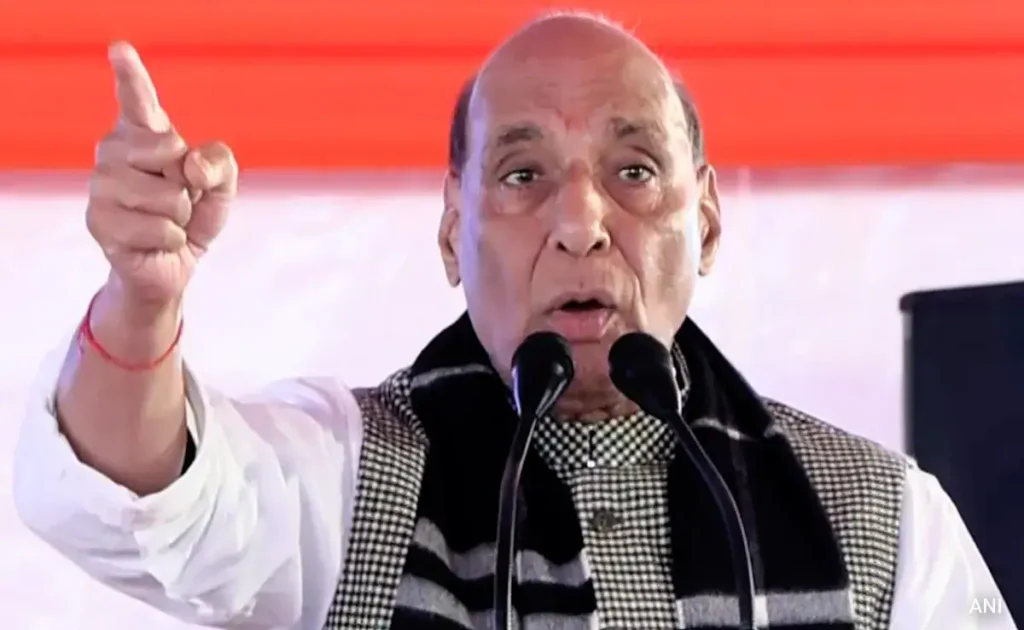
Indian Defense Minister Rajnath Singh has warned that India is fully prepared to launch "any kind of attack" against terrorism if Pakistan continues to use terrorism as a state policy. He stated that India wants peace, not war, and has no intention of capturing any other country's territory, but added that no compromise will be made on the issue of national security.
Rajnath Singh delivered this message to Pakistan while speaking at the NDTV Defence Summit on Sunday.
He stated that India believes in peace and never wants war. India also has no intention of occupying any country's territory in the world, nor does it intend to threaten anyone. However, there is a difference between peace and cowardice, and the whole world should understand this matter.
Rajnath Singh said that India wants peace, but under no circumstances will it compromise on national security. India believes in dialogue. However, if any country gives shelter and support to terrorism against India, the scope for dialogue with that country ends right there.
Issuing a direct warning to Pakistan, the Indian Defense Minister said that as long as the neighboring country continues terrorism as a state policy, India will remain fully prepared for any kind of attack against terrorism. At the same time, he said that this message is being given not only to the neighboring country, but to the entire world.
Rajnath Singh also brought up the remarks made by Indian Prime Minister Narendra Modi at the recent Shanghai Cooperation Organisation (SCO) summit. He said that countries that adopt terrorism as their policy and provide shelter and cooperation to terrorists must be given a clear message—under no circumstances can terrorism be anyone's strategic asset.
Rajnath Singh further stated that national interest will be the primary consideration in India's military operations and cooperation with other countries. India will neither conduct operations nor cooperate at the expense of national interest. Similarly, India does not want global stability at the cost of strategic autonomy.
While explaining India's global position, he also raised the context of the "Thucydides Trap". Rajnath said there are examples in history where a country becomes powerful, a potential for conflict arises with established powerful nations—but he noted that this concept does not fully apply to India.
According to him, India sees itself neither as a status-quoist power nor as a revisionist power. India is a civilizational power, and this reality also needs to be recognized.
This statement by Rajnath Singh came at a time when cross-remarks regarding terrorism and security are ongoing between India and Pakistan in various international forums. Earlier this month at the SCO summit, Prime Minister Narendra Modi called for dismantling the entire management of terrorism, including its financing, recruitment, radicalization, and safe havens.
Meanwhile, at the United Nations General Assembly as well, India reiterated its right to self-defense in combating terrorism. On Saturday, Indian External Affairs Minister S. Jaishankar said that any attempt to establish terrorism as normal is unacceptable, and India will exercise its right to self-defense against terrorism.
Earlier, in the UN General Assembly session, Pakistani Prime Minister Shehbaz Sharif raised the Kashmir issue and the India-Pakistan conflict of May 2025. He also mentioned the role of US President Donald Trump in halting that conflict. However, India has been rejecting US mediation claims for the resolution of that conflict.
The Indian side stated that on May 7, 2025, under "Operation Sindoor", India carried out strikes on terrorist infrastructure in Pakistan and Pakistan-controlled Kashmir. India stated that the operation was carried out in response to an earlier attack in Pahalgam in which 26 civilians were killed.
On the other hand, there is also a dispute between the two countries regarding the Indus Waters Treaty. Pakistani Prime Minister Shehbaz Sharif said in the UN that India's decision to suspend the treaty has no legal basis. He also warned that any effort by India to block, obstruct, or divert water on Pakistan's side would be considered by the country as an "act of war".
Meanwhile, India has been claiming Jammu and Kashmir as its integral part and has been opposing Pakistan's raising of the Kashmir issue in various international forums.