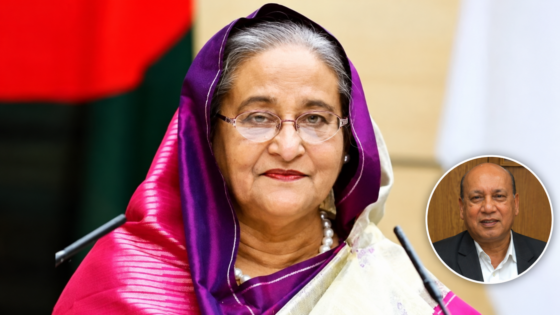
August is the month of suppressed cries and mourning for the Bengali people. It is in this month that a shameful chapter of history began. August is a month of human tears and eternal grief—a month that identifies the enemies and allies of the Liberation War. Bangabandhu and his family were assassinated in this very month, and a grenade attack was launched to kill Prime Minister Sheikh Hasina in August as well. Due to these numerous events, August is the month of mourning and weeping for the Bengalis. Upon the arrival of this month, Bengalis become overwhelmed by deep sorrow, turning as stone-cold as the phrase 'little grief makes one plaintive, greater grief turns one to stone.'
August 15, 1975, was a scandalous event in the history of the earth. That day was a Friday and India's Independence Day. At 4 a.m., Bangabandhu, the first president of independent Bangladesh and an influential politician of the Indian subcontinent, along with his family members, was assassinated. That ominous August 15 was engulfed in sorrowful and scandalous gloom. The entire world was stunned, paralyzed, and bewildered by this act of murder.
The Bengali nation was left speechless. However, the domestic and foreign assassin syndicate was jubilant. Bangabandhu deeply believed that no Bengali would kill him, which is why he moved about without security. Indira Gandhi had also warned him. Despite this, leaving the secure Ganabhaban, he lived inside that neighborhood in his simple, historic Dhanmondi residence. But alas, Bangladesh! How powerless you are! After the country was liberated at the cost of a river of blood, after seeing one's own grave dug in a Pakistani prison and returning from the scaffold, death comes on sovereign soil itself. Bangabandhu, who raised his index finger in speeches thousands of times against the Pakistanis to secure the self-determination of the Bengalis, faced brutal treatment from the assassins even towards that very finger. That index finger was riddled with bullets until it was gone. Yet, at the beckoning of this very finger on March 7, 1971, unarmed Bengalis had jumped into armed combat. It is clear to everyone that Bangabandhu was killed in revenge for the Liberation War. Those whom Bangabandhu nurtured, loved, and treated like his own children, brothers, and close ones throughout his life were the ones who turned traitors. Bangabandhu had created over 4 million loyal Awami League leaders and activists in his lifetime, but at the crossroads of his life and death, no role from them was observed. These events will make human civilization and humanity weep across ages and will torment the global conscience.
Prime Minister Sheikh Hasina stated in one of her writings: the muezzin is calling out the Fajr adhan, 'Assalatu khayrun minan nawm' (prayer is better than sleep). Muslims are heading to prayer, but the assassin squad cared nothing for the adhan and prayer; they were not going to a mosque, but to commit murder. Carrying jeeps, trucks, and military tanks, one group went in front of the house at flat 677, road 32, Dhanmondi; another group went to Sheikh Moni's residence on road 13; and yet another group went to Abdur Rab Serniabat's residence on Mintoo Road, 27. Hearing the sound of gunfire, Sheikh Kamal came downstairs, and Major Noor's (fugitive) cannon fire riddled his chest. As Bangabandhu came down the stairs, Major Huda, Noor, and Musleh Uddin shot him, causing him to collapse on the staircase. Thus, 18 people were killed, including Begum Fazilatun Nesa Mujib, Kamal's newlywed Sultana Kamal, Jamal's wife Rozi, child Russell, Bangabandhu's only younger brother, the disabled freedom fighter Abu Naser, Colonel Jamil, Siddiqur Rahman, Bangabandhu's sisters Amina Khatun and middle sister Afia Khatun, Sheikh Fazlul Haque Moni, his wife Arzu Moni, their two young sons, Agriculture Minister Abdur Rab Serniabat, daughters Beauty Rani Sahana and Bobby, son Arif, grandson Sukanto, brother's son journalist and martyr Serniabat, Naim Khan, and Mintu. After the murders, laws were even passed to ensure the killers would never face trial. Against the history of Bengali heroism, there also exists a history of betrayal.
Bangabandhu was an inseparable part of independence and the life consciousness of the Bengalis. How many conspiracies were hatched to erase Bangabandhu! But no one could, and no one ever will. Because history did not write Bangabandhu; Bangabandhu is an epic of the entire Bengali nation through his actions. In world history, he is the history and inspiration of subjugated and oppressed people. When Bangabandhu was banned in his own Bengal, a representative of Uzbekistan at a conference in the Cambodian capital of Phnom Penh from January 22 to 26, 2001, remembered Bangabandhu and said: 'Bangabandhu was a vocal personality for peace. We remember him at today's conference. Therefore, without any debate, Bangabandhu is the symbol of independence, the symbol of peace, the symbol of courage and valor. The person in whose name the doors of history open—even when that person dies, they walk the long road of history alongside mankind.'
On August 21, 2004, at 5:22 p.m., another barbaric event occurred. August 15 and August 21 were events threaded together in the continuation of a conspiracy. Sheikh Hasina was speaking on a stage built on a truck in front of the Awami League party office on Bangabandhu Avenue. At the end of her speech, the moment she uttered 'Joy Bangla, Joy Bangabandhu' and stepped toward the stairs, grenades exploded with a deafening sound. Thirteen grenades were hurled one after another. Within moments, the vibrant Bangabandhu Avenue turned into a city of death. Sheikh Hasina narrowly escaped with her life. The world witnessed hundreds of people crying out in pain, floods of blood, and the mutilated bodies of men and women scattered around. Party leaders like Mayor Hanif, Abdur Razzaq, Suranjit Sengupta, and Amir Hossain Amu tried to save Sheikh Hasina by forming a human shield. After battling death for 48 hours, 23 people lost their lives, including Ivy Rahman, the wife of late President Zillur Rahman. The blueprint to assassinate Sheikh Hasina had been crafted through a meeting at Hawa Bhaban. Mufti Hannan confessed the exact same in court. President Zillur Rahman wrote in an essay: 'I am in the midst of wailing, filled with terrible grief, pain, and emptiness after losing my wife.' Stricken by the grief of his beloved wife, Zillur Rahman himself eventually passed away.
Many events in the month of August bring tears to the people of this subcontinent. Mughal Emperor Jahangir on August 27, 1636; novelist Syed Mujtaba Ali on August 8, 1981; Justice Abu Sayeed Chowdhury, one of the organizers of the Liberation War, on August 2, 1987; and Gazi Shamsur Rahman on August 12, 1998, along with the killing of 50,000 people in the Calcutta riots on August 16, 1948, have earned the month of August its reputation as the month of Bengali mourning.
Regarding the tragic tragedy of August 15, the rural poet Jasimuddin said that what Deshbandhu Chittaranjan or Mahatma Gandhi could not achieve, Bangabandhu made possible. Bangabandhu is the uncrowned king of Bangladesh. After his death, he is the grand protagonist of a profound tragedy. If the Liberation War of '71 is the national epic of the Bengalis, then the protagonist of that epic is Bangabandhu Sheikh Mujibur Rahman. Come, new generation, let us weep silently with bowed heads. August is the month of crying with wide, futile eyes. Instead of merely observing mourning on the day of Bangabandhu's unnatural and tragic demise, let us instead remember the priceless achievements of his lifelong endeavors and follow his ideals. For he is Bengal's indomitable youthful Himalayas, the bright lighthouse in the pitch darkness of disaster. From generation to generation, Bangabandhu is the role model of the Bengali.
Author: Columnist and Social Analyst