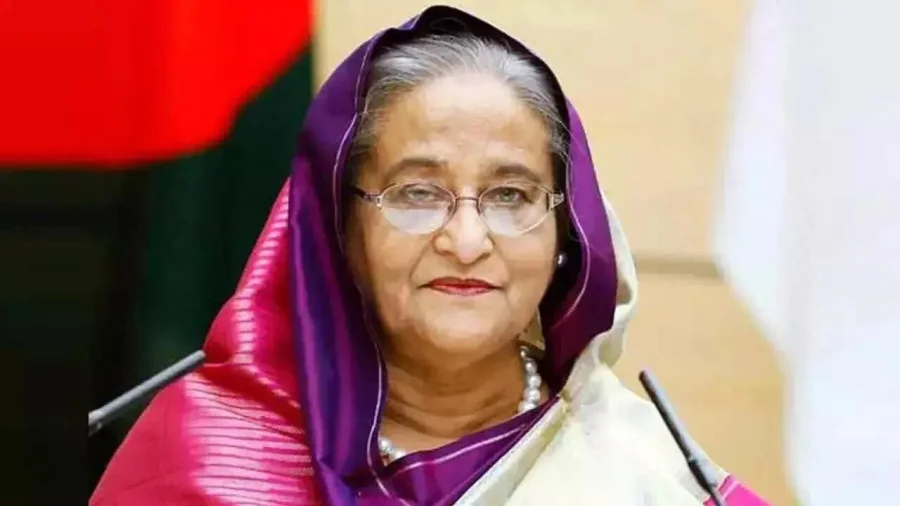
Today, Monday, is the 80th birthday of Sheikh Hasina, the elder daughter of the Father of the Nation Bangabandhu Sheikh Mujibur Rahman, the former Prime Minister of Bangladesh, and the President of the Awami League. She was born on this day in 1947 in Tungipara on the banks of the Madhumati River in Gopalganj.
She has achieved unbelievable success in many areas of national life, including the trial of war criminals, the prevention of militancy, the trial of Bangabandhu's self-confessed killers, the signing of the historic Chittagong Hill Tracts Peace Accord, the recognition of 21st February as International Mother Language Day, and serving as the pioneer of building Digital Bangladesh.
Sheikh Hasina, the first child of father Bangabandhu Sheikh Mujibur Rahman and mother Begum Fazilatunnesa, was nicknamed Hasu. Being the much-adored granddaughter of grandfather Sheikh Lutfar Rahman and grandmother Sahera Khatun, Sheikh Hasina's childhood and adolescence were spent in the arms of her grandparents by the Madhumati River in Tungipara. They are five brothers and sisters. The other four are Sheikh Kamal, Sheikh Jamal, Sheikh Rehana, and Sheikh Russell.
Except for Sheikh Hasina and Rehana, none of the siblings are alive. On the dark night of August 15, 1975, everyone including father Bangabandhu and mother Fazilatunnesa were killed at the hands of assassins.
Sheikh Hasina's educational life began in a primary school in Tungipara. In the 1954 elections, Bangabandhu Sheikh Mujib was elected as a member of the provincial assembly and brought his family to Dhaka. At that time, they moved into a rented house on Rajani Bose Lane in Old Dhaka.
When Bangabandhu became a member of the United Front cabinet, they started living with their family in the house at 3 Minto Road. Sheikh Hasina was admitted to Narisiksha Mandir in Tikatuli, Dhaka city. This educational institution is now known as Sher-e-Bangla Girls School and College. Her urban life and phase of living in the city began.
Sheikh Hasina passed her secondary examination in 1965 from Azimpur Girls' School and her higher secondary examination in 1967 from Intermediate Girls' College (currently Badrunnesa Government Women's College). In the same year, she enrolled in Dhaka University for an honors degree in Bengali language and literature and obtained her graduation degree in 1973.
Sheikh Hasina was elected vice-president of the student union while studying at Intermediate Girls' College. She was a member of the Dhaka University Chhatra League and general secretary of the Rokeya Hall branch. As a leader of the Chhatra League, she actively participated in the movement against Ayub and the 6-point movement.
In 1966, an unprecedented national awakening was created in East Bengal over the 6-point demands raised by Bangabandhu. Terrified, the ruling group arrested Bangabandhu. Intense repression began. While in detention, the Pakistani ruling group filed the Agartala Conspiracy Case against Bangabandhu. Deep fears of danger and unbearable suffering descended upon his life and family.
During these stormy days, at the behest of Bangabandhu, Sheikh Hasina was married in 1968 to nuclear scientist Dr. Wazed Miah. After Bangabandhu was arrested on the night of March 25, 1971, and taken to Karachi, Pakistan, the entire family was kept under house arrest in a different house in Dhaka.
While the War of Liberation was ongoing in besieged Bangladesh, Sheikh Hasina became the mother of her first child, 'Joy', on July 27, 1971, while under house arrest. Her daughter Putul was born on December 9, 1972.
Before Bangabandhu and his family were killed in 1975, Sheikh Hasina went to Europe with her younger sister Sheikh Rehana. While staying there, she received the news of the assassination of Bangabandhu and her entire family. As there was no environment to return to the country immediately, she left Europe and took political asylum in India with her husband and children.
The subsequent history of Sheikh Hasina is the history of how she became the leader of the Bengali nation in the journey of the 21st century. It is the history of taking the responsibility of realizing the dream of Golden Bengal that Bangabandhu used to see and becoming the guiding light for the Bengali nation.
She was elected as the party president at the biennial conference of the Awami League held from February 13 to 15, 1981. On May 17 of that same year, she returned to her motherland Bangladesh, ending 6 long years of exile.
In the 1986 parliamentary elections, she was elected from three constituencies. She led the historic mass movement of 1990. Following the 1991 parliamentary elections, she was elected as the leader of the opposition in the fifth national parliament.
In the 1996 elections, the Awami League won a majority and formed the government, and on June 23 of that year, she assumed office as the Prime Minister of the country.
In the 2001 parliamentary elections, she was elected as the leader of the opposition in the seventh national parliament. On August 21, 2004, a conspiracy was made to assassinate her by hurling grenades at an Awami League rally on Bangabandhu Avenue. Although she miraculously survived, 24 people were killed and five hundred leaders and activists were injured in that attack.
In the parliamentary elections held on December 29, 2008, the Awami League achieved a landslide victory by winning more than two-thirds of the seats. Through this victory, Sheikh Hasina was elected as the Prime Minister of Bangladesh for the second time. Later, winning the parliamentary election on January 5, 2014, she served as the Prime Minister of Bangladesh for the third time.
The Awami League president and former Prime Minister was ousted from power in the face of a student-people uprising. She is currently in India. Most of the party's leaders and activists are also 'in hiding.' The Awami League is in a rather disarrayed state. Consequently, no news of any official celebrations for the Awami League president's birthday has been found in the country yet.