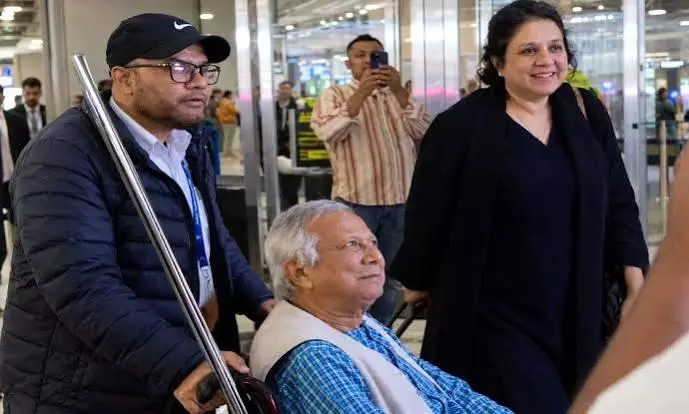
A video of the incident at the New York airport on October 12 has circulated on social media. The video shows several people shouting various accusations surrounding Yunus, who was in a wheelchair. Some of them could be heard saying, 'You are a terrorist,' and 'Why have you come here?' They also accused him of damaging democracy in Bangladesh. However, the truth of the allegations made in the video cannot be confirmed from that footage.
One Side's View: Despite Political Anger, Harassment Is Unacceptable
According to a section of social media users, people have the right to criticize the actions of any political leader or former head of government. But surrounding someone in a crowded place like an airport, humiliating them, hurling abuses, or intimidating them cannot be an acceptable method of protest.
Supporters of this stance argue that no matter how serious the allegations against an individual are, the response should come through information, investigation, and legal processes. Normalizing the tendency of personal harassment due to political rivalry could pave the way for the same behavior toward others in the future.
Following the incident, several former advisers of the interim government also condemned the harassment of Yunus. The Bangladesh government has also condemned the incident and stated it is in contact with US law enforcement agencies to identify those involved.
The Other Side's Question: Who Will Speak for the Victims of Mob Violence?
On the other hand, responses from many on social media brought up instances of mob violence and people taking the law into their own hands in various parts of the country during the interim government's term. Their argument is that when people raised allegations of collective attacks, beatings, humiliation, and loss of life during Yunus's tenure, the discussion should also include how possible it was to ensure remedy and accountability for those incidents.
Some in this camp argue that it is natural to raise questions about Yunus's role as the head of the government at the time when ordinary people were allegedly victims of mob violence. In their view, understanding people's anger toward him now requires considering past events, the experiences of victims, and the question of obtaining justice.
Part of this social media reaction draws on controversial events of his tenure rather than showing sympathy for Yunus. Some are even interpreting this as 'karma.' However, these comments reflect only a portion of public opinion; they cannot definitively determine the overall stance of the public or the specific number and culpability of past violence.
Should the 'Stance Against Mobs' Be the Same for Everyone?
At the center of this debate lies a fundamental question: Will opposition to mob violence apply only to individuals whose political stance matches one's own, or will the same policy be followed for everyone regardless of political identity?
Those opposing the harassment of Yunus argue that even with discontent over a person's tenure, public humiliating behavior toward them cannot be supported. Conversely, critics argue that alongside showing sympathy for Yunus, the allegations of mob violence during his government and the question of victims getting justice must be brought forward with equal importance.
Both positions involve questions of accountability. However, the allegations of past violence and the harassment that occurred in New York are two separate issues. Lack of justice for one does not justify another event. Similarly, opposing the harassment of Yunus does not mean stepping away from criticizing his tenure or demanding accountability.
Reflection of Political Polarization on Social Media
Therefore, the New York incident has not remained just a matter of protests surrounding a former head of government. It has reignited debate over Bangladesh's political polarization, memories of mob violence, allegations of impunity, and the limits of public expression of anger toward political figures.
Rather than pitting the condemnation of the treatment of Yunus and the criticism of his tenure against each other, it is essential to consider them separately. Just as it is necessary to ensure justice for people harmed in mob violence, it is equally vital to reject the tendency to harass anyone at the hands of crowds due to political rivalry.
Believers in democracy say that if the acceptability of mob violence is determined by who the victim is, the demand for establishing the rule of law is weakened. The doctrine that if the victim of a mob is from the Awami League it is an 'expression of anger,' but if it is someone 'anti-Awami League' it is 'terrorism,' cannot be acceptable in a civilized society.