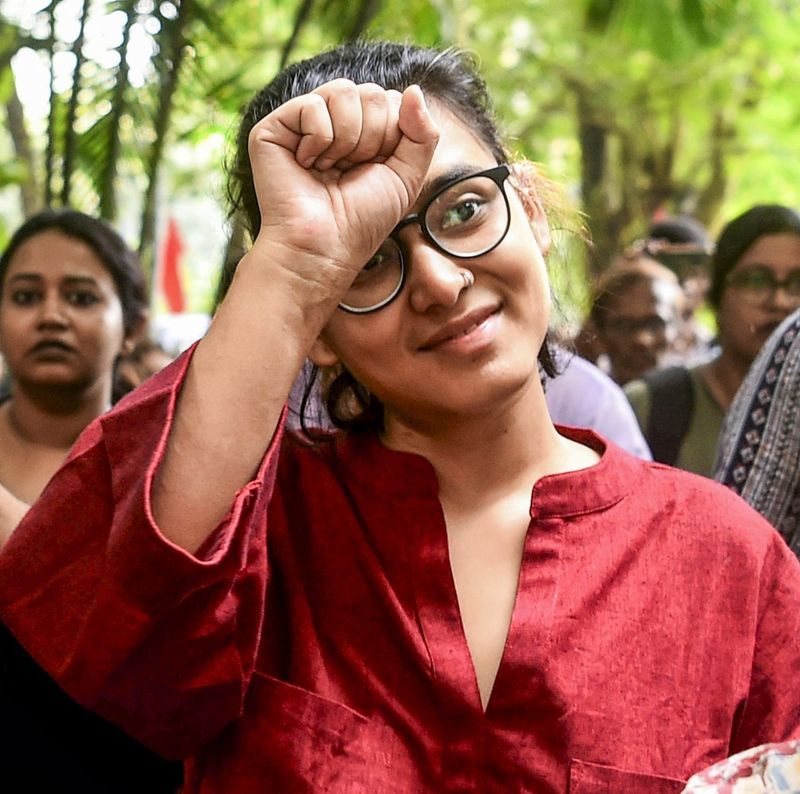
Neha Bora, President of the All India Students’ Association (AISA), did not support the 2024 anti-quota movement in Bangladesh (which later turned into a violent mass uprising) nor did she call for creating a similar situation in India. Certain extremist Facebook pages in Bangladesh, known as fundamentalist bot networks, circulated edited excerpts of a video message she had sent to the conference of a leftist student organization in Bangladesh. Based on these truncated videos, some Bangladeshi media outlets also reported that Neha Bora had drawn inspiration from the movement led by Nahid, Sarjis, and Hasnat. Some media outlets even portrayed her as a person in favor of creating a ‘situation like Bangladesh’ in India.
However, that recent video has surfaced again. Neha Bora strongly condemned those who used her as a commodity and propagated edited clips to gain political advantage.
After a short excerpt of Neha’s remarks spread, it created surprise among progressive circles in Bangladesh and India. It was propagated that the 2024 movement in Bangladesh was an example of a struggle against religious fundamentalism and that Neha was in favor of following that path. Yet, her speech was about the struggle of a specific leftist student organization, not about the 24 mass uprising of Bangladesh or the subsequent political situation.
On October 13, Neha sent a video message on the occasion of the 6th central conference of the Bangladesh Chhatra Front (BSF). This was because she and another AISA leader, Aditi Mishra, could not attend the conference due to passport and visa complications.
In her one-minute and forty-nine-second message, Neha raised the context of the Chhatra Front’s struggle in Bangladesh for democracy and the establishment of voting rights, opposition to religious fundamentalism, and the protection of an environment of independent thought in educational institutions. She also expressed concern over the shrinking of students’ rights in Indian educational institutions, the privatization of education, and the trend of ‘saffronization’ of education. She further called for working together to establish democracy and the right to education in South Asia. The logo of the Bangladesh Chhatra Front was also in the corner of that video. Bangladesh’s ‘bot network’ cropped out that logo so that Neha’s mouth could be used to glorify the ’24 movement. Extensive coverage in Bangladeshi media proved that they were also successful.
How the misleading claim spread: After the bot networks in Bangladesh propagated the videos, the media outlets of this country also promoted Neha’s speech with importance. From that very day, Neha’s immense popularity mainly suffered a setback, and the movement in India also lost momentum. Later, on October 15, BJP national spokesperson Pradeep Bhandari alleged that Neha wanted a repetition of Bangladesh’s Gen-Z movement in India. On the same day, a short excerpt of her speech was published on the official X account of the BJP. Later, various right-wing commentators and social media accounts spread the video claiming that she wanted to create a situation like Bangladesh in India. In some propagandas, she was also presented as a supporter of overthrowing the government through violence and killing Hindus. Republic Editor-in-Chief Arnab Goswami also interpreted the speech as a call to implement the ‘Bangladesh model’ in India.
Bazlur Rashid Firoz, general secretary of the Bangladesh Krishak Samiti and leader of the Communist Party of Bangladesh, said that Neha did not support the violence that took place in the Bangladesh movement; her speech was propagated out of context. Suchitra, former president of AISA and central committee member of the Communist Party of India (Marxist-Leninist), also said that the message was addressed to the workers of the SSF and that Neha spoke about the struggle of progressive students against religious fundamentalism.
In an explanation given on Instagram after the video spread, Neha stated that right-wing accounts removed the introductory part of the conference from the original video and used it for propaganda. When speaking about taking inspiration from Bangladesh, she did not mean the entire mass uprising or all the political forces that became influential later.
Written: Based on the English-language media outlet of India, NewsLaundry.