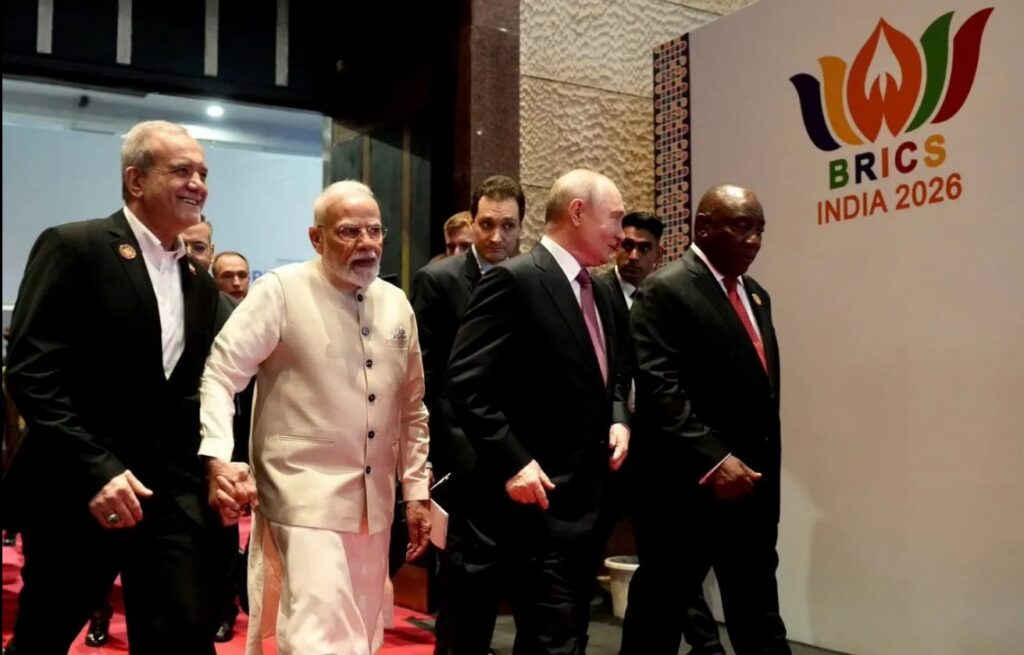
The two-day 18th BRICS summit begins today, Saturday, in India’s capital, New Delhi. Amid critical issues such as escalating global geopolitical tensions, the war in Ukraine, the conflict in West Asia, international trade, and energy security, leaders of several influential global nations are facing off at this year’s summit. The presence of Russian President Vladimir Putin and Chinese President Xi Jinping has lent special significance to this year’s event.
Hosted at Bharat Mandapam in New Delhi, the summit is attended by host Indian Prime Minister Narendra Modi, along with Putin, Xi, Iranian President Masoud Pezeshkian, and leaders of other BRICS member nations. United Nations Secretary-General António Guterres is also in Delhi surrounding the summit. The expanded BRICS is now a bloc of 11 member nations. Together, these countries represent approximately 3.7 billion people and account for roughly 40 percent of the global gross domestic product.
Chinese President Xi Jinping arrived in New Delhi on Saturday morning. In addition to attending the BRICS summit, his bilateral meeting with Indian Prime Minister Narendra Modi is scheduled for the afternoon. The meeting between the two leaders is scheduled for 5:45 PM local time. Bilateral trade and border-related issues are expected to receive significant focus in the discussions.
Xi’s visit to India this year carries distinct significance. This is his first visit to India since 2019. Following the lethal clash between Indian and Chinese troops in the Galwan Valley of Ladakh in 2020, relations between the two nations deteriorated drastically. Since then, friction has persisted between the two countries on various issues, including the border dispute. Consequently, Xi’s visit to Delhi is viewed as a crucial step in normalizing relations between the two nations.
Meanwhile, Russian President Vladimir Putin also arrived in New Delhi on Friday. Outside of the BRICS summit, he held a bilateral meeting with Indian Prime Minister Narendra Modi. The two leaders discussed enhancing cooperation in various fields including defense, energy, technology, the pharmaceutical industry, and people-to-people ties. Additionally, conflicts in West Asia and the Black Sea region, maritime trade, and the safety of Indian sailors also came up in the discussions.
The Russia-Ukraine war has also emerged as one of the key topics of discussion at this year’s BRICS summit. In his meeting with Putin, Modi once again called for moving toward dialogue and the path of diplomacy to halt the war. According to the statement from India’s Ministry of External Affairs, Modi expressed the view that dialogue and diplomacy are the correct path to resolve the conflict. The impact of the conflict in the Black Sea region is also affecting shipping and the safety of Indian sailors.
West Asian Conflict Also in Discussions
On the other hand, ahead of the BRICS summit, Modi held a meeting with Iranian President Masoud Pezeshkian. He emphasized restoring regional peace and stability as well as keeping maritime trade routes secure. With the tension surrounding the Strait of Hormuz and instability in the energy market, the Iranian President’s visit to Delhi has given the matter special prominence in the summit’s discussions.
Pezeshkian previously remarked that US sanctions and pressure on Iran have reached a ‘serious and dangerous’ stage. In his view, the current world is passing through unprecedented complexity. In this situation, how effective political and economic coordination becomes among BRICS members and partner nations is also drawing attention at this year’s summit.
Emphasis on BRICS Economic Cooperation
Discussions are also expected at this conference on further deepening economic cooperation. India’s Minister of Commerce and Industry Piyush Goyal has proposed linking the payment systems of BRICS nations with one another, increasing trade in local currencies, and further facilitating digital trade.
He has highlighted India’s digital payment system, UPI, as a potential foundation for cross-border financial cooperation among BRICS nations. Initiatives to trade in local currencies and strengthen mutual payment systems are seen as part of the efforts to increase the influence of BRICS in the international economy.
Just as the political and economic importance of the bloc has increased following the expansion of BRICS, internal differences have also become more pronounced. On issues such as alternative payment systems, China’s influence, the war in Ukraine, and the conflict in West Asia, the positions of member states are not always identical. Consequently, building a consensus at the summit is viewed as a major diplomatic challenge for India.
How United is the ‘Voice of the Global South’
BRICS began with four countries: Brazil, Russia, India, and China. Later, the bloc expanded to become an 11-member group. Among the new members are Iran, Egypt, and Ethiopia. While the expansion is seen as the bloc representing a large portion of the global South, the differences in the geopolitical positions of the members have also increased.
According to analysts, BRICS is no longer just an economic cooperation platform; it has transformed into an important stage for increasing the influence of developing and emerging economies outside of Western power in global politics. However, due to differences in the interests and strategic positions of member states, forming a common stance on major international issues is becoming difficult.
For India, therefore, this year’s summit is simultaneously an opportunity to strengthen relations with China and Russia, and a test to preserve strategic relations with Western countries. New Delhi wants to maintain BRICS as a platform for economic and multilateral cooperation rather than turning it into an anti-Western bloc.
Consequently, the outcomes of this two-day summit may give prominence not only to the future direction of BRICS, but also to the war in Ukraine, the conflict in West Asia, global trade, energy security, local currency transactions, and the role of emerging nations in the international economic system. Especially, the international community is now eyeing the results of the Modi-Xi and Modi-Putin meetings and how far BRICS leaders can reach a common position on major international crises.