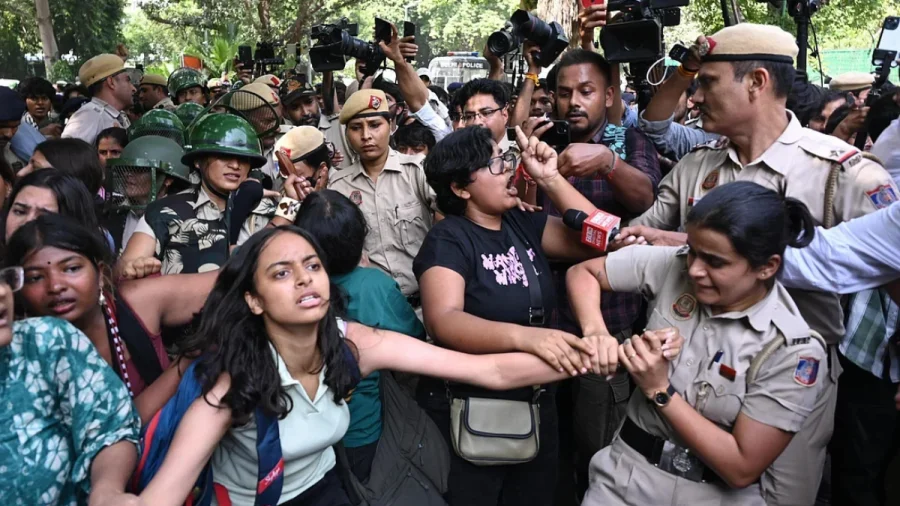
Delhi Police have taken strict security measures surrounding the protests at Jantar Mantar in Delhi, demanding the resignation of Indian Chief Election Commissioner Gyanesh Kumar. Although permission for the protest was not granted, approximately 4,000 police and paramilitary personnel were deployed in connection with the Friday, October 2 program.
According to the Hindustan Times, citing sources familiar with the matter, telecom service providers such as Airtel, Reliance Jio, and Vodafone Idea were instructed to suspend internet services within a 1.5-kilometer radius of Jantar Mantar from 9 AM to 9 PM local time.
A Delhi Police official stated that district police, reserve forces, the Rapid Action Force (RAF), and other paramilitary forces have been deployed. Information from a report by The Wire indicates that 20 companies of the Central Armed Police Forces (CAPF) have also been assigned security duties.
On Friday, the Delhi Metro Rail Corporation (DMRC) announced that entry and exit points for 11 metro stations would remain closed until further notice. These include Janpath, Patel Chowk, Central Secretariat, Rajiv Chowk, Seva Tirth, Mandi House, Lok Kalyan Marg, INA, Chawri Bazar, Ramakrishna Ashram Marg, and New Delhi. However, interchange facilities remained available at Rajiv Chowk, Mandi House, INA, New Delhi, and Central Secretariat stations. Later, the entry and exit points of the Barakhamba Road metro station were also closed, bringing the total number of closed metro stations around the protest site to 12.
Meanwhile, Delhi Police stated on Thursday that no organization had been granted permission to protest against the Election Commission at Jantar Mantar this week. However, the All India Students' Association (AISA) announced a protest program there for Friday at 11 AM. On September 28, a delegation led by AISA President Neha Bora also submitted a letter to the Parliament Street police station regarding the program.
The Indian Youth Congress had also requested permission to protest at Jantar Mantar, but they were not granted permission either. The police suspect that a large number of protesters could gather at Jantar Mantar, and according to reports, additional forces were requested from the Ministry of Home Affairs for this reason.
Multi-tiered barricades have been erected in and around Jantar Mantar and adjacent areas. Barricades have been placed at various points including Tolstoy Marg, Janpath Road, and Sansad Marg leading to Jantar Mantar. Entry to the protest site has also been blocked from two directions: Tolstoy Marg and Kerala House, with barricades additionally set up near Ashoka Road.
The protests have raised demands for the resignation of Gyanesh Kumar. Organizers accuse the Election Commission of irregularities in the Special Intensive Revision (SIR) of voter lists and in the conduct of elections.
This marks the fourth time this year that major restrictions on public transport and road systems have been imposed in Delhi due to protests. Last month, during student protests in the capital, the Supreme Court issued a notice to the central government over the closure of 17 metro stations.