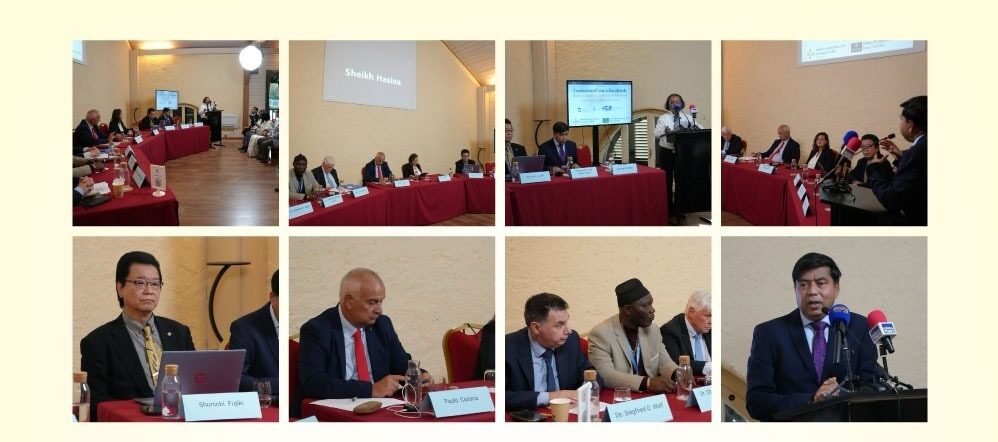
GENEVA, Switzerland: Comprehensive discussions on Bangladesh's current constitutional order, rule of law, human rights, political participation, and judicial independence were held at an international seminar organized at the Geneva Press Club.
Former political leaders, lawyers, human rights activists, and international researchers from Europe, Asia, and Africa participated in the seminar titled "Constitutional Crisis in Bangladesh: Right to Education, Arbitrary Detention, and Fabricated Tribunal Verdicts." The keynote paper was presented by Sheikh Hasina, former Prime Minister of Bangladesh and President of the Awami League.
Sheikh Hasina stated that Bangladesh is going through a severe constitutional crisis. The events of July-August 2024 did not bring peace or prosperity to the country. She emphasized that the future of Bangladesh must be determined through the free and conscious will of the people, not through fear or coercion. She accused the current authorities of arbitrarily detaining and burdening thousands of Awami League leaders, activists, and supporters with false cases out of political vengeance.
She strongly criticized the use of the judicial and tribunal processes as tools for political revenge. She noted that no election can be meaningful or representative if a major political force is excluded.
Sheikh Hasina called upon the United Nations, human rights organizations, and Bangladesh's international partners to closely monitor the situation in the country and step forward to end arbitrary detentions and political persecution.
Professor Dr. Md. Habib E. Millat, President of the Global Center for Democratic Governance, stated in his speech that the rule of law, judicial protection, and the safety of citizens in Bangladesh are severely disrupted.
He claimed that due to their political identity, millions of people have been internally displaced, thousands have been killed, and more than 200,000 students are outside educational institutions.
Mentioning that the Awami League, the country's largest political party, has been banned indefinitely, he highlighted attacks on journalists, the suppression of press freedom, and the inhumane conditions faced by imprisoned political activists and leaders.
Paulo Casaca, a former Member of the European Parliament, stated that the current situation in Bangladesh should not be viewed merely as a simple political crisis or constitutional dispute; it is a broader democratic crisis. He remarked that the suppression of freedom of expression, pressure on journalists, and the tendency to exclude political opponents are signs of an authoritarian regime.