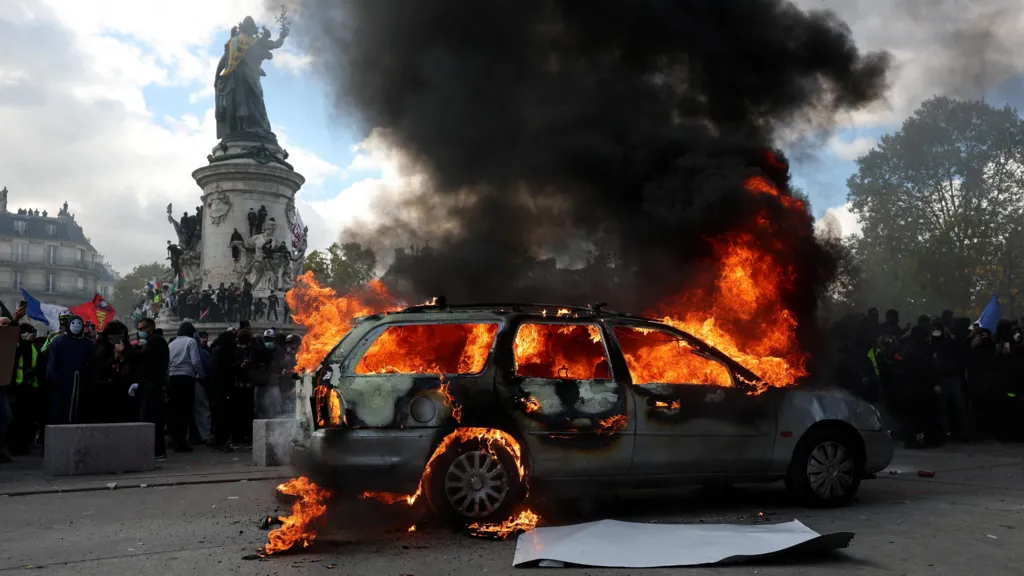
The fires of protest across France have steadily turned into terrifying violence. Driven by soaring living costs, fuel price hikes, and crises in educational institutions, millions of people took to the streets, turning various cities across the country into volatile flashpoints on Saturday. As the protests unfolded, clashes, arson, looting, and widespread vandalism broke out. In the capital, Paris, repeated clashes between police and protesters pushed the situation out of control. Government buildings, businesses, and vehicles were set on fire in various locations. Highlighting the severity of the situation, the French government described it as a dangerous escalation of violence. At least 1,200 people have been arrested nationwide, and at least 150 police officers have been injured.
An estimated 550,000 people participated in Saturday's protests. Although the main march in Paris was relatively peaceful in the afternoon, the situation changed dramatically as evening fell. Several groups of protesters set fires on the streets, torched cars, and attacked various shops. To control the situation, riot police used tear gas and water cannons. In some places, police were seen chasing and baton-charging protesters.
Vehicles were also set on fire in Paris's historic Place de la Republic area. Various shops were looted, and at least one restaurant was extensively damaged by fire. In addition to the capital, reports of violence and vandalism emerged from Lille, Lyon, Grenoble, Marseille, Rennes, Toulouse, and several other cities. An Apple store in Lille was attacked and its goods were looted. Clothing and grocery stores were also looted in Paris.
Historic Buildings Engulfed in Flames
The terrifying picture of violence was evident in the city of Limoges, where a large fire at the city hall caused a part of the building's roof to collapse. Similarly, the mayor of Lyon, Gregory Doucet, expressed deep concern over an arson attack on the city's tourism office building. He described the burning of the historic and well-known building as a tragedy for the city.
According to local police, some unruly individuals obstructed firefighters from safely carrying out firefighting operations, further complicating the situation. Reports of damage to public and private infrastructure were also received from various cities including Grenoble, Avignon, Pau, Montpellier, and Valence.
Meanwhile, in the southeastern city of Saint-Etienne, a young man had his hand blown off by a small explosive device, according to the city's mayor, Regis Juanico. He remarked that such an incident should never happen.
Public Discontent Stemming from Educational Crisis
One of the main reasons for the recent protests in France is the crisis in secondary educational institutions. Over the past few weeks, hundreds of students have protested in various lycees across the country over teacher shortages, dilapidated infrastructure, and the educational environment. Students in these institutions are typically between 15 and 18 years of age.
Members of various labor unions and ordinary people angered by the rising cost of living have joined the students' movement. Groups associated with the Yellow Vest movement, which emerged in 2018 to protest fuel and living cost hikes, have also joined the agitation. That movement eventually turned into one of the longest-running mass protests in France's recent history.
The government has, however, tried to take some steps to resolve the crisis. On October 8, Education Minister Edouard Geffray promised to hire an additional 3,000 temporary teachers. But that did not stop the protests; instead, the scale and intensity of the movement increased.
Political Heat Ahead of Elections
This violence has erupted at a time when France is going through deep political uncertainty. President Emmanuel Macron's term will end next year. According to opinion polls, the contest between National Rally leader Marine Le Pen and La France Insoumise leader Jean-Luc Melenchon is expected to intensify around next April's presidential election.
Melenchon, who participated in the protests, accused the police of using excessive force. However, he also condemned the looting and arson. Prime Minister Sebastien Lecornu criticized his statement as a dangerous and tactical political stance.
Lecornu said that an extremely high level of violence was directed against the police. He also accused certain groups of using the protests as preparation to display their political strength ahead of the presidential election. He stated that no one can impose their political agenda through violence.
On the other hand, Marine Le Pen accused the far-left of taking control of the protesters' legitimate demands and pushing them toward violence. President Macron has also announced that those involved in attacks and looting of government offices, businesses, and city halls will face justice.
This recent unrest in France is no longer limited to the cost of living or the crisis in the education system. Street anger, clashes with police, and mutual accusations by political parties have complicated the situation further. While the government is trying to appease public discontent on one hand, it has adopted a hardline stance to suppress the violence. However, following Saturday's massive clashes, new concerns have arisen over which direction the nationwide protests will take next.